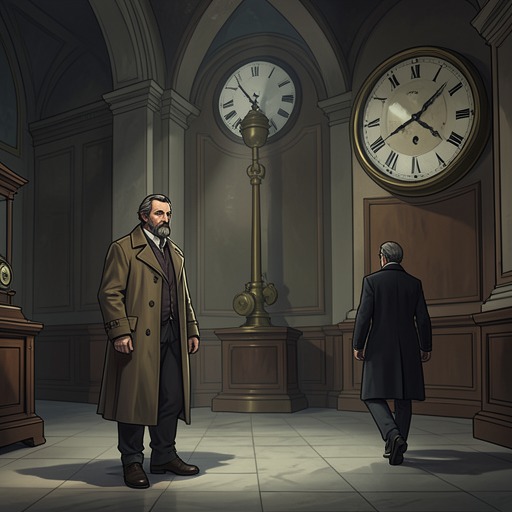
Don Fabrizio–Tancredi Falconeri relationship
The LeopardThe relationship between Don Fabrizio Corbera, Prince of Salina, and Tancredi Falconeri is at once familial, protective, political, and financial. After Tancredi’s father squandered the family fortune and died, Don Fabrizio became the boy’s guardian; affection then made the obligation more than formal. He cherishes Tancredi’s vitality and intelligence, shields him from the consequences of political risk, and ultimately helps secure a marriage that can restore the young man’s prospects. Their bond also exposes the compromises of a changing society: Don Fabrizio’s care for his nephew is sincere, but it is exercised through the same networks of property, influence, and alliance that are remaking Sicily.
Guardianship and Affection
Tancredi’s father, who had married Don Fabrizio’s sister, exhausted his fortune before his death. When the widow later died, the King entrusted the fourteen-year-old Tancredi to his uncle. The family’s estate had collapsed so completely that even the silver braid on its liveries had been swallowed by ruin; the surviving Falconeri villa stood half-ruined beside the Salina property. Don Fabrizio nevertheless supported his ward, later giving him money from his own pocket without resentment.
The Prince’s preference for Tancredi is partly a response to the young man’s distinctive character. He sees in him a zest for life and a frivolous temperament unexpectedly interrupted by serious moods. Though he does not admit it, Don Fabrizio would rather have Tancredi as heir than his own son, Paolo, whom he regards as a fool. His judgment combines indulgence with clear-eyed appraisal: Tancredi is dear to him, but the Prince also recognizes his charm, ambition, and ability to adapt.
This attachment is not merely sentimental. Don Fabrizio’s guardianship places him in the position of intervening when Tancredi’s choices bring danger. After the April disturbances, he expends effort and makes visits to officials to keep the young man from getting into serious trouble. He does not treat Tancredi’s political involvement as a reason to withdraw his protection. Instead, he tends to excuse the nephew by blaming the disorder of the times, even when he recognizes that Tancredi has chosen risky company and associations.
Political Risk and Mutual Dependence
Tancredi’s political loyalties complicate, but do not dissolve, the family bond. While moving in a circle of gamblers and fashionable women, he sympathizes with the revolutionary movement and makes contact with the secret National Committee. Don Fabrizio understands that the young man may be drawing on both political and royal sources of money. The Prince is therefore not an uninformed guardian: his affection coexists with awareness of Tancredi’s opportunism and of the dangers surrounding him.
Other people read the relationship as a source of protection. Don Pietro Russo, a dependent of the Prince who is himself maneuvering to acquire property, assures Don Fabrizio that Tancredi will not be away long and suggests that the Prince’s kinship with the young man will help keep the family safe through political change. The reassurance humiliates Don Fabrizio, who resents the implication that his security depends on Russo’s local connections or on being Tancredi’s uncle. Yet the exchange makes visible the practical force of the bond: family standing and personal alliances operate as political resources when official power is uncertain.
Don Fabrizio’s earlier dealings with the court also place the pair within a web of personal patronage. He recalls audiences granted by King Ferdinand, while his own efforts to protect Tancredi from scrutiny show how inherited access can be put to use on behalf of a younger generation. But such protection has limits. Tancredi’s political choices are his own, and the Prince cannot make the changing political order conform to the older forms of loyalty in which he was raised.
Marriage as Care and Strategy
The prospect of Tancredi’s marriage first reaches Don Fabrizio through a conversation about Concetta. Father Pirrone reports that she believes Tancredi’s increasingly open attentions mean a proposal is imminent and asks what her answer should be. Don Fabrizio questions whether she can judge the young man’s intentions so confidently, then turns inward to the practical obstacles: Concetta’s dowry would be limited by the division of the family fortune, while Tancredi needs substantial resources. He considers the wealthy families who might offer a more advantageous match and recognizes that romantic attachment alone cannot settle the question.
Tancredi’s letter changes the situation. Written on fine paper in a carefully prepared hand, it announces his love for Angelica Sedàra and asks his uncle to approach her father for her hand. Its polished presentation and tactful address allow the request to be treated as serious business, while its separate discussion of political and family union can be shown or withheld independently. Tancredi presents the marriage as a joining of an old family and a newly influential one; Don Fabrizio sees that argument as confirmation of his own understanding of how social change can preserve aristocratic standing through alliance.
The Prince’s response brings together affection and calculation. He is pleased that Tancredi has chosen a match likely to provide lasting financial security, and he imagines the young man’s happiness and future opportunities. At the same time, he feels the discomfort of having to negotiate an intimate family matter with Don Calogero Sedàra. The negotiation makes plain that the Prince’s support is not simply approval of a love match: he must help translate Tancredi’s name and prospects into terms acceptable to a wealthy new family.
The Settlement and Its Consequences
When Don Calogero confirms that Angelica returns Tancredi’s affection, Don Fabrizio’s relief is genuine. He embraces the Mayor, then speaks for Tancredi’s family and character. He praises the antiquity of the Falconeri line, recounts its standing under successive rulers, and presents Angelica as a fitting addition to it. He also vouches for Tancredi, emphasizing his promise and ability to advance despite his reduced circumstances. The Prince’s praise carries irony as well as pride, but his personal confidence in his nephew is unmistakable.
He must also disclose the damage to Tancredi’s inheritance. His father’s extravagance and the failures of his administrators have cost the family its estates near Mazzara, pistachio woods at Ravanusa, mulberry plantations at Oliveri, and palace in Palermo. During his guardianship, Don Fabrizio managed to save the villa, partly through legal maneuvers and personal sacrifice. The account establishes both the limits of what he can give Tancredi and the care with which he has tried to preserve something of the young man’s inheritance.
Don Calogero’s offer transforms the match’s material prospects. He assigns Angelica the Settesoli estate, measured at 644 salmi or 1,010 hectares, together with olive groves and vineyards at Gibildolce; he also promises twenty linen sacks containing 10,000 ounces of gold each for the wedding day. Don Fabrizio is astonished by the scale of the settlement. His reaction registers discomfort at the social and financial gulf between the families, but the resources promise Tancredi a security his birth alone can no longer provide. In this exchange, the uncle’s earlier support meets the new wealth that will underwrite his nephew’s future.
A Bond Shaped by Change
Don Fabrizio continues to support Tancredi in the ordinary details of family life. When Tancredi arrives at the family gathering with Count Carlo Cavriaghi, wet from the rain, the Prince arranges rooms, warmth, and refreshments. Tancredi then writes Angelica a brief note announcing his arrival and intention to visit her; Don Fabrizio approves the message, amused by his nephew’s style and pleased to assist the courtship. Such gestures make his guardianship active and affectionate, not merely a past legal duty.
The relationship also informs Don Fabrizio’s later political judgment. When Cavaliere Aimone Chevalley di Monterzuolo seeks his consent to a Senate nomination, Don Fabrizio declines and recommends Don Calogero instead, arguing that the latter has practical power and is suited to the new order. He notes that Tancredi’s generation will need to maneuver in a political world where personal interests can be presented as public ideals. The advice does not diminish his attachment to Tancredi; it shows how thoroughly he understands that affection and advancement now depend on adapting to institutions and alliances beyond the old aristocratic household.
Their bond therefore links private care to historical transition. Don Fabrizio protects Tancredi from danger, lends him money, preserves what he can of the Falconeri inheritance, and supports his marriage to Angelica. Tancredi, in turn, embodies the energetic generation whose political flexibility the Prince recognizes even when it unsettles him. The uncle’s devotion helps the nephew move forward, but the means of that future—political calculation, property, and a wealthy marriage—also mark the fading power of the world that Don Fabrizio represents.